
"Strolling in Xintiandi" (pronounced shin-tan-dee) is one of the most advertised tourist activities in Shanghai.
Why? I asked, as I "strolled" past Starbucks, peered at the savory French chain, "Paul," made my way down a cobblestone alley full of 4 star fusion restaurants, into a stone-clad fashion mall with Versace and Shanghai Tang, finally ending up at Nine West.
What was different about Xintiandi than any other affluently-aestheticized shopping plaza?
Because, as CLEARLY advertised, Xintiandi is the next best thing to authentic--i.e. what I might call "contemporary historic" architecture. Or, as wikipedia defines it, a "lifestyle center."
In Xintiandi's case, traditional 1920's Shanghai "shikumen" architecture is blended with contemporary commercial luxury brands and fine dining to produce "a visual feast that will both intrigue and fascinate you." (http://www.xintiandi.com/english/events.asp).  (image from http://www.xintiandi.com/english/events.asp)
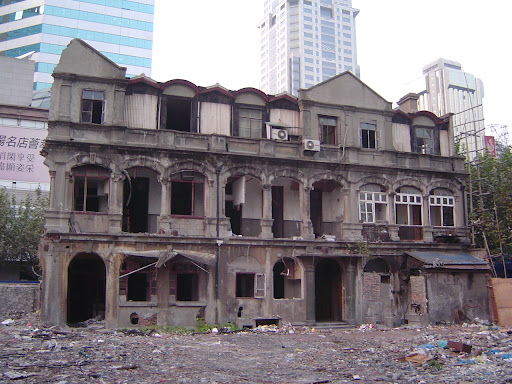
 To create "old Shanghai" shikumen-housing, the several-city-block complex is a combination of 2-3 storey townhouses connected and arranged with alleys (entrances are demarcated by a celebratory stone arch.) Therefore, Xintiandi's structure, fake shudders and all, is an "adaptive reuse" project with a product that privileges interior activity while seemingly pleasant (i.e. not a 100+ storey tower) from its exterior, street-level vantage point.
The effect? That when you enter Xintiandi, it is as if you are supposedly no longer in downtown Shanghai, but rather a quaint reproduction of what was demolished (well, partially restored) to build it in the first place.
So is this example of "trans-historical space" a success or banal oxymoron? And does recreating historic architecture now advertised as both "the City's Living Room" as well as a place "where East meets West," have a place on a tourist map?
I could lie and say my office's proximity to Xintiandi is unfortunate, but as a temporary ex-pat with a limited tolerance for Chinese cuisine, I would argue that Xintiandi is not a complete failure, but rather, false advertising. Xintiandi shoud absolutely target tourists. But not as a means of experiencing authenticized Shanghai.It is charming, and a fantastic alternative to the generic skyscraper. And it even has a snug fit (I don't dare say "contextual) as a part of Shanghai's urban mish mash.  Instead, Xintiandi should shake off its "emperor's new clothes" and stand naked in its true form: "If you miss home, go to Xintiandi: a centrally-located, charming Chinese-themed Western shopping mall!" After all, honesty is the best policy...
and trust me, plenty of tourists will still go for a frappuccino and croissant.
7.7.08
Synthetic/Authentic/Generic? Examining Xintiandi


Subscribe to:
Post Comments (Atom)
No comments:
Post a Comment